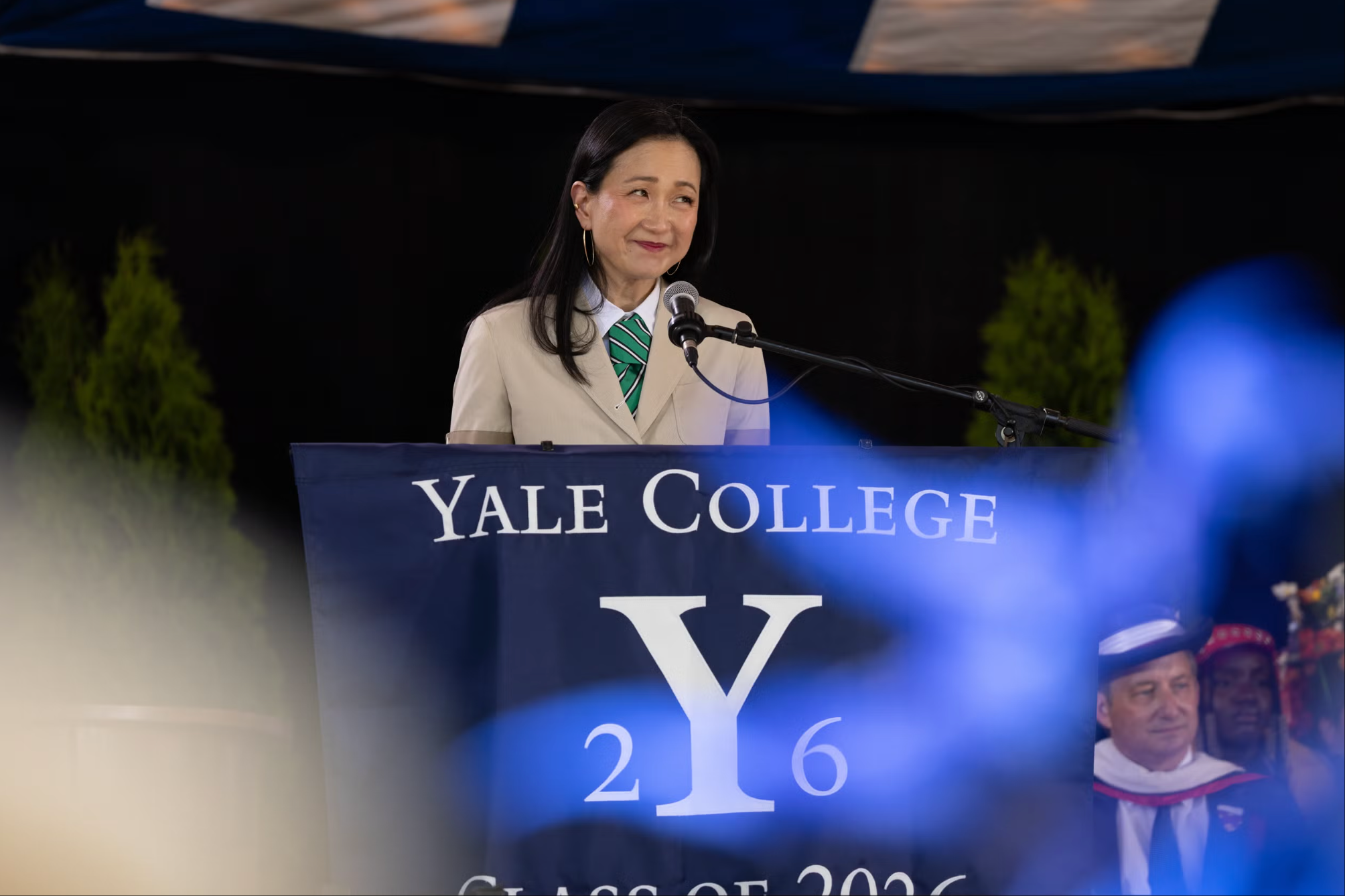
Good afternoon. President McInnis, Trustees of the Yale Corporation, Dean Lewis, Provos Strobel, Heads and Deans of the Residential Colleges, Professor Allison Coleman, Class Day Committee Members, Isha, Maya, Sarah and Kevin.
Faculty administration, and staff, thank you, class of 2026 for your gracious invitation.
And class of 2026, congratulations.
Let us acknowledge together the sacrifice, the dedication and love of your parents, family members, guardians, and friends. We hold in our hearts every person who could not be here today because of work, illness, financial circumstances, or military service.
In the past decade… I have lost two of my… It started fast today. I lost two of my brilliant college roommates before they turned 50. Jan Wang Jo, Davenport class of 1990. Kashka Coopsdella, Trumbull, 1990. This past December, we lost the environmental journalist, Tatiana Schllossberg, Trumbull class of 12, who served as the Editor-in-Chief of The Yale Herald.
Among us gathered today, we have lost too many too soon. However, may their lives and love shine through these beautiful graduates.
On Class Day of 1990, I was sitting where you’re seated, and I was set to go to law school at Georgetown. I don’t know how I got in. No, truly.
In preparation for this speech, I revisited my mediocre transcript. I had far more B’s than A’s. As evidence, I will share that I got a C in sculpture and a C plus in modern Chinese history. Some of you will graduate summa cum laude, magna cum laude, or cum laude. My friend, Neil, and I used to joke that we graduated. “Thank you laude.”
I feel seen. Okay.
In your seat, I was not thinking about the brightness of my future, but rather, my limits. It had not been my plan to go to law school. I was a history major and I had wanted I had wanted to become a history professor, but I didn’t have the grades or the faculty support to get a PhD. And also at Yale I learned that I had a very serious liver disease.
And on my Class Day I felt disillusioned with my political ideals, betrayed by my own body, alienated from some of my classmates, and I felt ready to leave campus. Above all, I wondered if I had wasted my four valuable years at Yale.
I went to law school. I got a job as a lawyer at a firm in Manhattan. And after working for only two years, I quit my high paying job to write fiction.
I was 26 years old. I had no idea how to write a novel, so it turned out that I had gone into the wrong profession. So obviously I had chosen the wrong major. So I would have to start at square one. Again I asked myself “Had I squandered another 5 years of my life?”.
And from that moment on, it took me another 12 years to publish my debut novel, “Free Food for Millionaires”. And I was 38 years old. And when I was sitting in your chair, that was like a 100.
My second novel, “Pachinko”, came out when I was 48. That’s like 110. So that’s another decade. However, I had gotten to study the whole idea to study the Koreans in Japan when I was in college. so off and on, I’ve been working on that book for almost 30 years.
My third novel, “American Hagwon”, will come out in the fall when I will turn 58. I look good, right?
I love the class of 2026.
And when young writers… (audience cheering) When young writers ask me, “How should I become a novelist?”, out of due consideration for their precious youth, my first thought is, “Shouldn’t they be asking somebody else, someone who is far more efficient and productive?” So for most of my life, I have felt there was something really wrong with me.
I was too slow. I was slow to learn how to talk. I was slow to learn how to make friends. I was a slow learner. I even take twice as long to eat my meals than most people. Three decades, three novels, and I’m not a fast writer. And as a child, my father had named me “Turtle”, because of my pace.
At Yale, I did not know how to find mentors. I was not tapped by any societies or clubs. I said and wrote things which upset important people. And I was… (audience cheering and applauding) And I was so dumb or naive that I didn’t know who was important in the world. And it turned out that all the important people knew each other. So if you made trouble, and I did, everyone important or who aspired to be important avoided you.
So it can be reasonably argued that I did not use my time well in college, and that I had missed my opportunities, and class of 2026, since last May, when I received the invitation from President McInnis, I have been thinking about you every single day.
I have been thinking about what your generation has experienced and is experiencing, a pandemic, deadly invasions and wars, mass school shootings, wildfires, climate change, inflation, the destruction of voting rights, AI, clip economies, attention economies, the enshittification of tech platforms, rampant economic inequality, lack of affordable housing, the rise of neoliberalism and authoritarianism.
And then there’s ICE and DOGE, the loss of reproductive rights, health care inequality, the spectre of unemployment and underemployment, government corruption, the drastic cuts to scientific research, the death of local news, and the loss of legacy media, the loss of cherished ideals and hard won constitutional liberties for all people, but especially for members of historically oppressed communities and the rise of distrust in each other. As we approach our national Semiquincentennial, and now the Hanta virus. Good fucking grief.
You are the so-called “anxious generation”, a label I have been considering. To me, you are rightfully aggrieved.
You have been forced to be alert. No, you have been forced to be hyper vigilant. And you deserve credit for being the adaptive generation. The more we’re made aware, the more we may be shaken. But in our most difficult trials, you and I cannot afford to panic. Rather, we need to make sober decisions by being steady and clear-sighted. But how?
Often, I’m asked, what advice do I have for young people? And I share this precept which has carried me through every difficult question. Choose the important over the urgent.
Choose the important over the urgent. A text message or a DM may seem urgent, but rarely is it important. Any addictive impulse feels urgent, but you know it isn’t important and too often it will lead to our demise. So “fine”, you say. So we know when something isn’t urgent, but then how do you know it’s important?
And for me, I started to see what is important when I began to understand the concept of time. The ancient Greeks, that’s right, Greeks. The ancient Greeks have two words for time, “Kronos” and “Kairos”. With these two words, I wanted to create a set of task glasses, a pair of time bifocals, so you can have two perspectives both near and far.
I want to take a moment to note that Benjamin Franklin, the namesake of our young residential college, who received an honorary master’s degree in Yale in 1753, is credited for having invented the bifocals.
I wanted to drop some knowledge for Benjamin Franklin. In our era when rapid change is our constant, I want you to have these time bifocals for you to either wear around your neck, like a middle-aged writer, or to carry in your breast pocket, like a secret tool, so that whenever you face an unfamiliar situation, or experience something you may not understand, you can put them on, as the author and historian of your life.
The first ancient Greek word, “Kronos” is a word for time, and that could be measured like clock time. If I said “20 minutes isn’t enough time for lunch”, that time would be Kronos. Kronos is the spine of storytelling. When a story starts, the clock starts. As the author of your life, you know that the Kronos is ticking.
The second ancient Greek word for time is “Kairos”, which means the opportune time, a strategic opening or in theology, a divinely appointed season. So when you see the romantic partner of your life, of your dreams, and you sense the right time to approach them, we’re talking about Kairos. The plural of Kairos is Kairoi. Each life is filled with Kairoi.
Kronos, quantitative, that’s measurable time; Kairos, qualitative, opportune time.
Class of 2026, I imagine that each of you is familiar with the pressure of Kronos.
Nearly all high achievers are Kronos people. Will I finish graduate school in 6 years? Before I turn 30? Will I have enough money in the bank? When will I get a partner? Will I give birth to a child before 40? Perhaps you have a five-year-plan or a 10-year-plan.
I can imagine that each of you is made hopeful and anxious by these Kronos-related wishes, because often, there are benchmarks with the attendant deadlines. The compound word “deadline” even reminds us, deadline, with mortality. We can feel the movement of the clock.
In Homer’s “The Odyssey”, I think we have a classicist here. Kairos occurs when the hero, Odysseus, takes any decisive action. When he tricks a monster, he outwits the sirens, and finds his way home to his family. In a theological context, Kairos tells you what matters and when.
And some of you may be familiar with the verses from Ecclesiastes. “There is a time for everything, and a season for every activity under the heavens. A time to be born, a time to die, a time to plant, and a time to uproot.” That time and time to uproot is Kairos.
Graduating from college and going to the next stage of your life is Kairos. You and I are here in Kairos, and as an author, it’s my job to have lots of Kairoi. The main character, and I’m feeling a lot of main character energy here, must have big wishes, overcome challenging obstacles and be transformed by Kairoi. When you’re the author, you have to know ahead of the reader what those essential transformative moments should be, so the reader keeps turning the pages.
However, in real life, when you’re the main character, not always obvious what’s critical. So…when I put on my dual perspective time glasses to review my college years, what seemed deeply painful, or even insignificant, or actually Kairoi.
50 years ago in 1976, I immigrated to this country with my family when I was seven. Thank you. It was the year of the Bicentennial. Then 10 years later, in the fall of 1986, I entered Old Campus for my first day at Yale. I was 17, because I was born in November, and young Scorpio in the house. I was born in November and I was really young for my class. I wore large horn rim glasses, that slid down my nose. I wore no makeup, and my hair was bobbed short, cut by my mother at home in the kitchen near the sink with a large thin towel draped over my shoulders. I did not have much of a wardrobe. I was so proud to own one pink and white rugby shirt from Land’s End, which I thought would be preppy enough for Yale. Later, I got a job as a sales clerk in downtown New Haven at Ann Taylor to improve my clothing options and to fit in.
My mother and father worked in Manhattan’s Koreatown in a tiny wholesale jewelry store, maybe 200 square feet, and they sold inexpensive costume jewelry to small shop owners in the New York area, and to street peddlers who sold their wares on card tables at a markup near the subway stations. Growing up and during college breaks, my sisters and I worked at our parents’ store.
Yale was the school of my dreams. I wanted to go to Yale because in high school, my favorite writer was Sinclair Lewis. That’s one person. That’s good. He is remembered, if remembered at all, for his social novels, “Main Street”, “Babbitt”, “Arrowsmith”, “Dodsworth”, and “It Can’t Happen Here”. Back then, there was no internet or Wikipedia, but in the back flap of my library books, Lewis’s biography mentioned this college. And I wondered what he had learned at this school to write such important novels about social history and politics.
I applied early, got deferred, and then eventually was accepted through regular admissions, in April 1986. I graduated from the Bronx High School of Science, the greatest high school in the world, and became a member of the class of 1990, and was assigned to Trumbull College, the greatest residential college at Yale. When I arrived on campus, I sort of expected that Sinclair Lewis would be here. He was not. He had graduated in 1908.
On my first day at Yale, my father took time off from work and my mother stayed behind to watch the store. They worked six days a week and they could not close the shop because their rent was high, and their customers who had limited resources and replenish their stock daily needed them to remain open. I wonder how many of you might have had family members or friends who could not come today, because they’re back home, tending to their stores or restaurants, or taking care of a family member. My father drove me to New Haven, helped me unload the car to my room in Durfee Hall, then went right back to work.
And when I graduated in 1990, I did not ask my parents to attend Class Day, because I didn’t want to bother them with driving at night, or having to stay at a hotel. It seemed like too much to ask my parents to use up two days for one graduation. They attended Commencement, but not Class Day. However, my parents are here this afternoon. On your Class Day, it may take 36 years Kronos, but it all works out, Kronos.
My parents did not know what I did at school. Nothing. They were not involved in my classes or my major, they just trusted that I would figure it out.
And in my sophomore year, I decided to major in history. In the summer… In the summer, between my first and second year at Yale, I went to Korea to study the Korean language at Yangtze University, my mother’s Alma Mater.
When I returned to Yale, I wanted to learn more about Korea. I took the only class that I could, which was a college seminar at Davenport taught by Dr. Hesung Chun Koh, who founded the East Rock Institute. She’s 96 years old and she’s here today.
It was the only class. There was nothing else. Yale was supposedly world-renowned for its East Asian studies, but in 1988, I could not find any department course on Korean history, language, religion or literature. Nothing.
How could any history or political science major understand the Cold War without knowing the history of Korea?
Two American men, Dean Rusk and Charles Bonesteel, both only 36 years old. They had never been to Korea, but they had proposed the division of the peninsula at the 38th parallel in August of 1945. Over 35,000 American soldiers died in the Korean War. The division of Korea is also American history.
I wanted a better education, so I decided to do something. Kairos.
Dr. Koh said that for years, Yale students had been trying to get at least the Korean language off the ground. She introduced me to a senior, Harry Nam Berkeley, class of ’88. Harry would be so proud. So, in my sophomore year, I decided to start up the Korea Studies Task Force. Harry kindly attended meetings and served as co-chair of this task force before graduating in a few months.
I wrote several letters. I drafted a formal letter to the Chair of the East Asian Studies Department asking for classes relating to Korea studies. Then I asked a friend at the Yale Divinity School to translate the letter into Korean. I went to Taiko and I photocopied the letters. I bought stamps for 200 envelopes with my own money.
Then I called a meeting and gathered students and leaders from different student organizations who would support Korea studies. And at the meeting, I asked 200 students to send the letters to their parents and then to ask their parents to send the letters to the college administration. And they did. Yale parents are very special.
Things started to change. Parents sent those letters to then-President Benno Schmidt, and some added fierce arguments of their own. I know because I read dozens of them when I visited the archives two months ago.
Here I wanna thank Mike Lotstein and Jeannie Lurie, the university archivists, for finding boxes of these letters.
History is our collective memory, but it is interpretation based on evidence. Yale had been saving these primary documents.
So, class of 2026, keep your receipts.
In the fall of my junior year, students and parents sent those letters and the school announced that the Korean language would be taught the following year, in the fall of 1990. A generous parent had pledged $100,000 to seed a three-year pilot program for the Korean language.
Harry Nam had already graduated, so he couldn’t benefit from the language classes. And neither would I, because the classes would start the year I graduated. The Korean language classes started at Yale in the fall of 1990. They have been taught continuously for 36 years. Out of the 55 languages that are taught at Yale, Korean language is the fifth largest language program by enrollment and the second most popular Asian language at Yale after Chinese.
The Korea Studies Task Force had asked for history classes as well, and in my junior year, I learned that Yale’s first Korean history class would be taught in the spring. I signed up right away, and then I got sick.
In high school, I had donated blood and the Red Cross had written me a letter saying that I was a chronic hepatitis B carrier, so I should never give blood. In high school, I was asymptomatic, so I didn’t think much of it, but during the winter of my junior year, it turned out that I was infected.
Gradually, I recovered from the symptoms, but the doctor at Yale New Haven Hospital told me that it was more than likely that I would get liver cancer in my 20s or early 30s. I dropped two classes so I could stay in school, but I kept Korean history. I did not know how much time I had. Kronos.
In the spring of 1989, a Yale history professor, a renowned authority in Japanese history, taught the Korean history class. Sixty students enrolled and I was overjoyed to take the class which I fought to have. I attended every class. I asked questions and I studied hard.
When I took the midterm exam, the professor failed me. On the blue book at the end of the handwritten essay test, the grade was F, and he wrote the words: “Amy, what’s to say?” That was the extent of his comments. No rubric, no guidance, and no respect. Kairos. What would I do?
After the midterm exams were handed out, several students were visibly upset. I learned that many of the students who had failed or gotten poor marks were of Korean descent. I raised my hand in front of the whole class and I asked the professor for a gender and ethnic breakdown of the grading. Kairos.
At the outset of the next class meeting, the professor wrote out the grading data on the chalkboard focusing on gender and who was ethnically Korean, which was over half the class. Fifteen students of Korean descent, or almost half of all the Koreans, received marks of C or below. And he failed five ethnically Korean students.
After he gave out the grades, he speculated that the reason why so many Asians had gotten C’s, D’s, or failed was because most Asians were math and science majors who do not know how to write a history midterm. I was a history major. Kairos.
I wrote a letter to the Yale Herald. Then the Yale Observer broke down the data and reported that the professor did not know what our majors were. And it was indeed incorrect to assume that just because you’re Asian, that you were in fact a math or science major. The Yale Observer reported that it was incorrect to assume that math or science majors did not know how to write history midterms, or that a person in an Asian body should naturally know the history of her ancestors.
After I wrote that letter to the Yale Herald, a fellow Korean-American student wrote a letter defending the professor and called me paranoid. Another student wrote that I was a politically correct terrorist.
I felt so stupid for having started the Korean Studies Task Force and I was ashamed at having campaigned for a Korean history class. I had publicly disagreed with a powerful professor in the department of my major, which was not a strategically good decision. And not soon after I received a death threat in the mail, which I brought to the campus police because I was frightened.
However, from unexpected corners, I received profound care. I’m a Presbyterian, the granddaughter of a minister, but somehow I was connected to Rabbi James Ponet, a university chaplain who wrote me an encouraging letter when he learned of the death threat. He wrote: “Your capacity to express outrage makes you a valuable citizen.” Also, my dear friend Judy Ciolano, who worked as the grill cook at Trumbull College Kitchen, invited me to her home, and she cooked chicken casserole for me. Judy’s here today.
Their kindness gave me the courage to remain enrolled in the class. Three of the six students who failed the midterm dropped the course. I stayed and received a B minus for my final grade in Korean history.
That same semester, the second semester of my junior year, the head of Trumbull College, who was also the university chaplain, Harry Adams, invited me to attend what was then called a Master’s Tea.
The college tea featured a white American missionary who served the poor Koreans in Japan. He told a story about a 13-year-old boy, an ethnically Korean child who was born in Japan. After his middle school graduation, the child went to the roof of his building and he jumped to his death.
His parents were devastated. They did not know why he had committed suicide, so they went through his things and discovered his middle school yearbook. And in this yearbook, his classmates had written: “Go back to where you belong. I hate you. You smell like kimchi.” And his fellow classmates, other middle school children, had written the words: “Die, die, die.” I would never forget the story.
Before that college tea, I had known nothing about the Koreans in Japan and how they struggled to survive in a colonial nation that had little use for them after the nation was defeated. There were no classes about Koreans in Japan, but I resolved to learn more about it. I resolved to do something about it. And my time at Yale had given me the valuable tools to teach myself the things I needed to know, because of that college tea. Because of that college tea, one hour of four years, I have been privileged to spend decades of my life trying to understand the political nature of dehumanization, the power of resistance, the beauty of human resilience, and the much needed grace of strangers. I wrote “Pachinko” because I went to a college tea.
At the end of my junior year, I submitted an essay I had written in a non-fiction seminar to the English Department for prize consideration. The class was taught by the incredible writing professor Fred Strebeigh. And back then you had to submit your work without your name on it. And the professors from the English department judged it. And at the end of May of 1989, I received a certificate in the mail. On blind submission, I had won the Henry P. Wright Prize for non-fiction for the best described article upon a prescribed subject, and it came with a check for $165, which was the first time I was ever paid for my writing.
In the fall of my senior year, I was lucky, so lucky to get into a hot American seminar for history with another famous historian. For my first paper, I wrote on Jane Addams’ “Hull House”. I admired Jane Addams, because she had helped poor European immigrants and led major social reforms in Chicago. The professor gave me a C and when I went to see him during office hours, he said that I needed to get remedial help for my writing because English was my second language. This was the second professor in my department who thought I was a foreigner, who could not do well in the subject that I loved, because I didn’t know how to write or argue in English.
However, the English department had just given me a prize for non-fiction. An award judged by Yale professors with PhDs in English who did not know the identity of the writer.
I was 20-years-old, and a doctor at Yale New Haven Hospital had already told me that I might die of liver cancer before turning 30. So I waited until the professor finished speaking, and I made a Kairos decision. Informed by my limited Kronos, I knew I would not write another letter to the school newspaper. I faced that historian and I said, “Professor, it’s not that I don’t know how to write. It’s that you don’t know how to read.” I dropped that class.
I completed the requirements of my major, but I decided not to apply to graduate school in history. I took more literature classes and college writing seminars. And in the second semester of my senior year, I submitted a short story again on blind submission for prize consideration to the English Department. This time a work of fiction.
On Commencement day, the day after Class Day, my fellow Trumbullians and I returned to Trumbull Courtyard. And when the awards were announced, I had won the Veach Prize for fiction. Another check for over $100.
Professors that I admired in the subject that I loved, in the department of my major, told me that I was a middling student at best and that I couldn’t know how to write well. And professors who did not know me in the English Department gave me prizes in non-fiction and fiction.
Class of 2026, I want you to know this. I am grateful for all of it, the unkindness, the misunderstandings, as well as the encouragements, the unexpected gracious recognition, and the extraordinary tools of our Yale education. Because all of it, all of it, the gaslighting, the generosity, and the development of our innate intellectual curiosity prepared me for my life after graduation.
Right after college, I went to law school. And right after law school, I married my husband Chris when I was 24. Kronos. I met Chris when I went to a party with my friend Richard Reed, Timothy Dwight, class of ’90. Kairos.
I practiced law for less than two years and I quit my job to write fiction. Knowing that my life would be severely curtailed, I decided that I would value my Kairos. My husband and I had our son, Sam, when I was 29. When Sam was three years old, I developed liver cirrhosis, a significant risk factor for liver cancer. I was 32 years old. I never had a drop of alcohol. The Yale New Haven doctor, his prognosis came true like clockwork. Kairos hit the fan.
My gastroenterologist in New York put me on an experimental trial of interferon B and for several months, I gave myself shots. And in that season of my life, I lost my hair. The blood vessels in my face would break every time I sneezed or bent down to pick up something from the floor. I vomited and had diarrhea so badly that I could not leave the house. However, the drugs worked and I’m fully cured. My doctor said it was a miracle.
Kairos means opportune time. And you could interpret this to mean that like Homer’s Odysseus, you must always be decisive, always canny to figure out how to get home. I didn’t live that way. If anything, I’ve learned that Kairos happened in spite of me, not because of me. My part was to do what ordinary people can be expected to do.
To address the important needs, to keep learning when you don’t know things, to keep doing your share of the work, and to keep showing up. An author may choose the Kairos moments for her characters, but not always for herself. A historian can look back and spot them to find meaning.
Finally, I want to share the most surprising things that I have learned about time. Time is not your enemy. Time is your friend. Any dream that turns real will become complex and uncertain. And that is when you need to stare hard at it and struggle honestly. Nothing, nothing was wasted about your time here if you let the brightest and the darkest moments teach you to struggle better with truth. Time is our teacher.
And you, class of 2026, will not be shaken because you are well equipped for what lies ahead. Class of 2026, when you put on the bifocals of time, you will see straight through the fog of confusion, the fear mongering, and the anxiety-provoking chaos. The world sometimes wants to shake us with its urgency. But I want you to know that you can be steady, wise, sober, and surefooted because you are better prepared when you can see the truth and importance of that situation.
Class of 2026, congratulations on your milestone achievement. We are rooting for you. We are proud of you.
Thank you.
Transcript generated from publicly available video content. All rights belong to the original copyright owner.